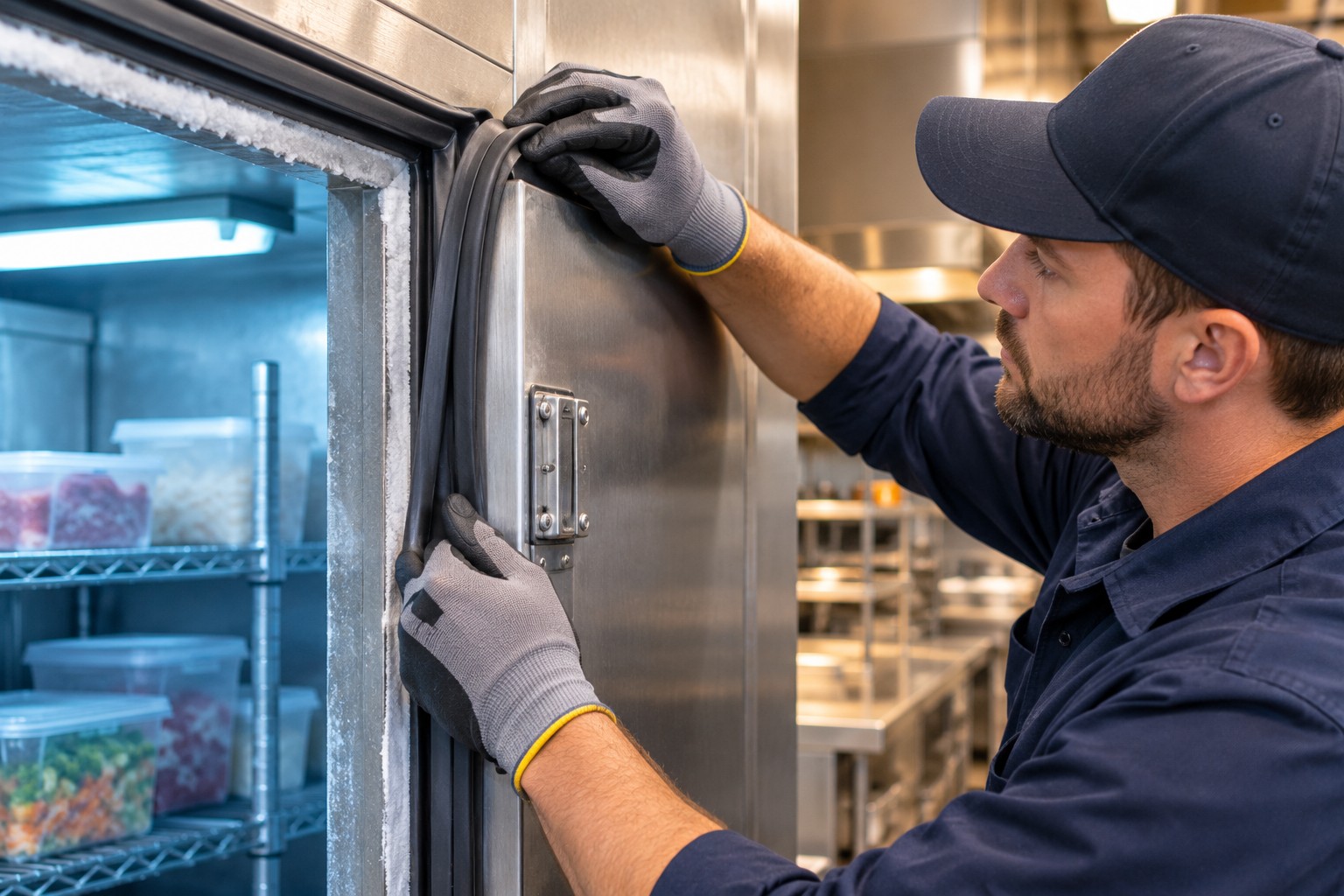
Choosing the right commercial freezer door gaskets decides whether a walk-in holds 0°F or bleeds cold air all day. A worn seal lets warm, humid kitchen air in, builds frost around the frame, and forces the compressor to run longer. Gaskets Rock makes custom-fit freezer seals and installs them through Managing Partners across the United States, Canada, and Mexico, typically within 3 to 7 days.
What Do Commercial Freezer Door Gaskets Do?
Commercial freezer door gaskets are flexible seals that close the gap between a walk-in freezer door and its frame, keeping cold air in and warm, humid air out so frozen product stays at a safe temperature.
That matters because food stored constantly at 0°F or below stays safe: freezing to 0°F or below inactivates microbes that would otherwise spoil food. Once the seal weakens, the freezer has to fight a steady stream of kitchen air, and the first signs show up as frost, temperature swings, and higher power use.
How Can You Tell a Walk-In Freezer Door Gasket Is Failing?
A walk-in freezer door gasket is failing when it is cracked, torn, hardened, or moldy, when frost forms around the door frame, or when the door no longer closes with a firm, even seal.
| Warning sign | What it usually means | Next step |
|---|---|---|
| Cracks, tears, or missing sections | The seal is broken and air passes straight through | Replace now |
| Frost or ice along the frame or gasket | Warm, humid air is entering and freezing at the edge | Inspect this week |
| Door drifts open or needs a hard push | The gasket is flattened or stiff, or the door is out of alignment | Inspect this week |
| Hardened or flattened rubber | The gasket has lost its compression | Plan a replacement |
| Black or green mold in the folds | Moisture is trapped where cleaning cannot reach | Clean once, replace if it returns |
| Light or visible gaps with the door shut | The gasket is not touching the frame all the way around | Replace |
| Compressor runs longer, power bills climb | Leaks are adding load to the system | Check the seal and the run time |
How to Check a Walk-In Freezer Door Gasket in Five Minutes
- Inspect the full length of the seal, including corners, for cracks, tears, mold, and hardened sections.
- Close the door on a thin sheet of paper or a dollar bill at several points around the frame, then pull. If it slides out with no resistance, the seal is not gripping at that spot.
- Look for frost, ice, or light along the frame while the door is shut.
- Confirm the door latches without extra force. A door that sags or rubs points to worn hinges and handles rather than the gasket alone.
- Log the box temperature for a few hours. Swings that line up with door activity point to an air leak.
What Types of Commercial Freezer Door Gaskets Are Available?
Most replacement freezer seals fall into three groups: push-in (dart) gaskets that seat in a channel, screw-in gaskets held by a retainer, and magnetic gaskets that pull the door tight. A fourth seal, the bottom door sweep, closes the gap at the floor. Gaskets Rock supplies gaskets for all of your cold-storage equipment across reach-in and walk-in units.
| Gasket type | How it mounts | Common use | Watch for |
|---|---|---|---|
| Push-in (dart) | A barbed dart presses into a groove on the door or frame | Reach-in units and many walk-in doors | The wrong dart size leaves gaps |
| Screw-in (retainer) | A retainer strip and screws hold the seal in place | Heavy-duty doors in high-traffic kitchens | Loose screws let the seal lift away from the frame |
| Magnetic | A magnet strip inside the gasket pulls it to a steel door | Reach-in units and some walk-in doors | Weak magnets or trapped debris break contact |
| Bottom door sweep | A strip on the bottom edge of the door closes the floor gap | Walk-in doors, paired with door sweeps and closers | Wear from floor traffic and cleaning |
How to Choose Commercial Freezer Door Gaskets That Fit
The best commercial freezer door gaskets match your door’s exact profile, length, and corner style, and stay flexible at freezer temperatures. Use this checklist before you order:
- Match the profile (cross-section), not just the length of the old gasket.
- Confirm the make and model from the data plate. Gaskets Rock covers many of the equipment brands we service.
- Check the corners and hinge side, where most gaskets tear first.
- Choose a mold-resistant compound that stays supple in sub-zero use.
- Ask the supplier to verify the profile instead of guessing from a catalog photo.
What Gasket Material Holds Up in a Walk-In Freezer?
Look for a flexible, heat- and mold-resistant compound that keeps its shape after thousands of door cycles. Gaskets Rock seals are made with heat- and mold-resistant material and are free of lead, mercury, and cadmium, so they are suited to food storage areas.
Custom-Fit vs OEM Walk-In Freezer Door Gaskets
Custom-fit gaskets are built to match your door’s measured profile, while OEM replacements are the manufacturer’s stock part. In Gaskets Rock’s experience, OEM seals are often not designed for the intensity of restaurant use and can fail early.
| Factor | OEM replacement | Custom-fit from Gaskets Rock |
|---|---|---|
| Fit | Stock part for the original model | Matched to the profile recorded for your unit |
| Durability | Often not built for heavy restaurant use | More robust, heat- and mold-resistant material |
| Food-area safety | Varies by supplier | Free of lead, mercury, and cadmium |
| Re-ordering | Look up the part again each time | Make, model, and profile kept on record after the audit |
| Turnaround | Depends on the dealer and stock | Typically 3 to 7 days, depending on location |
Commercial Freezer Gasket Replacement: How It Works
Replacement starts with a free audit of your units and ends with a custom seal installed by a local Managing Partner. Gaskets Rock’s gasket service for every cooler and freezer in your kitchen follows the same five steps at every location:
- Audit your freezer units at no cost to identify the gasket profile on each door.
- Label every unit so your make, model, and gasket profile stay on record.
- Produce a custom-fit seal matched to that profile.
- Install the new gasket through our walk-in freezer seal installation service, typically 3 to 7 days from order, depending on your location.
- Re-order from the saved record whenever a seal wears out, with no re-measuring.
Gaskets Rock is based in Pittsburgh, Pennsylvania, with Managing Partners across the United States, Canada, and Mexico. Find the Managing Partner nearest you for service in your area.
What Does a Failing Freezer Seal Cost Your Kitchen?
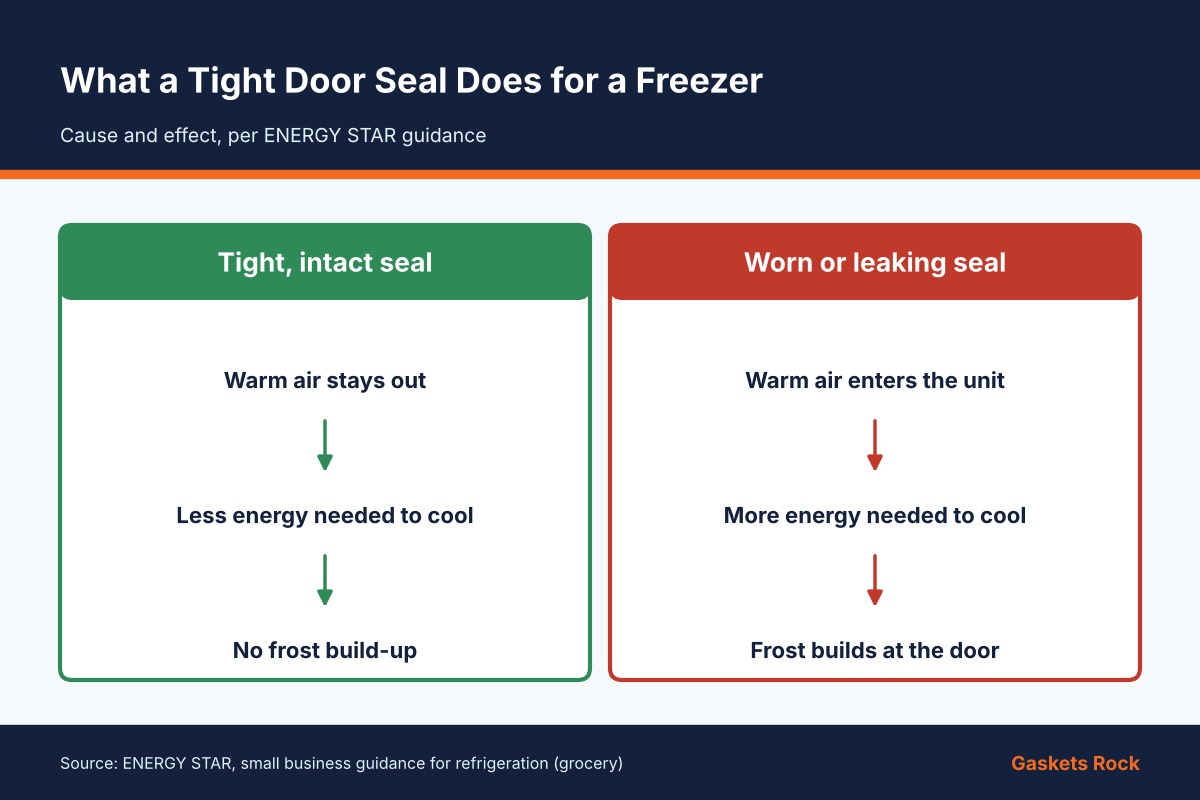
A failing freezer seal costs you in three places: energy, product safety, and inspection risk. ENERGY STAR notes that tight seals and properly closed doors keep warm air out of the unit, cut the energy needed for cooling, and prevent frost build-up.
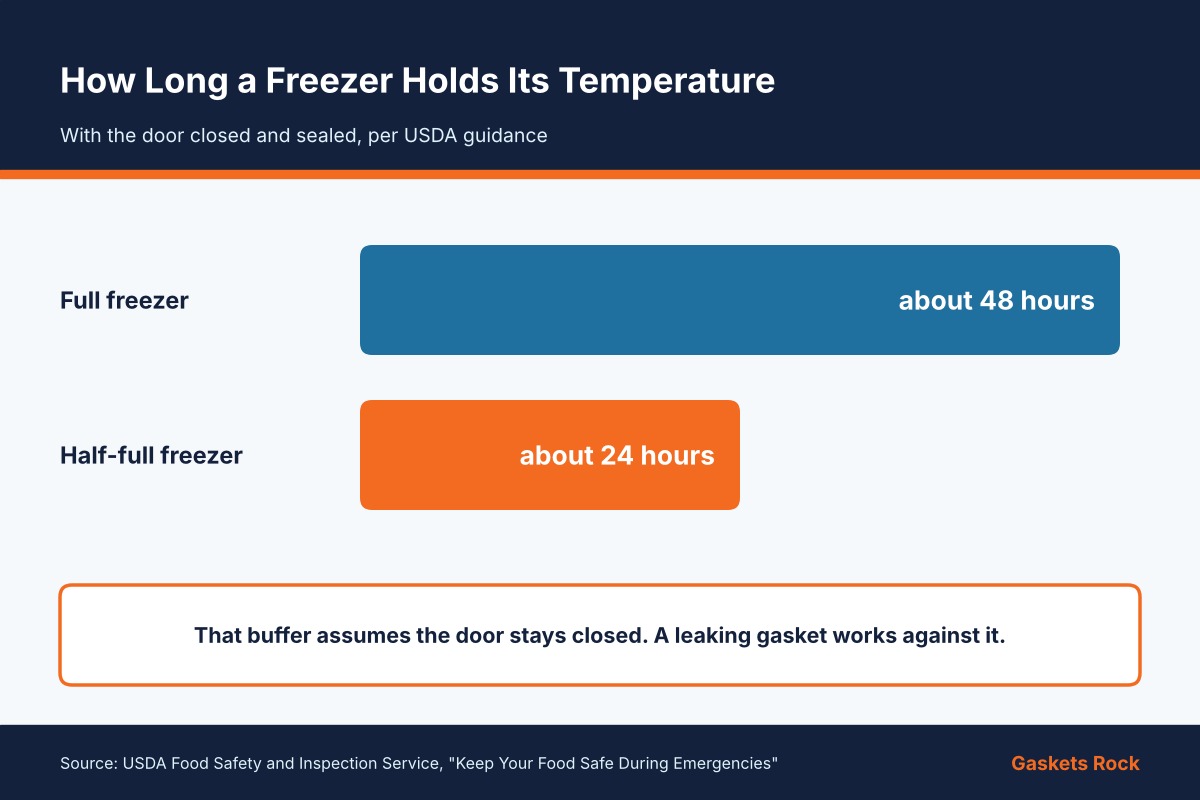
The safety side is just as direct. USDA guidance says a full freezer holds its temperature for about 48 hours, and a half-full freezer for about 24 hours, but only if the door stays closed. A leaking gasket erodes that buffer every hour the compressor is catching up.
| Cost area | What a leaking gasket does |
|---|---|
| Energy | Warm air enters, so the compressor works longer to recover |
| Frost and ice | Moisture freezes at the door edge and can stop the door from closing cleanly |
| Product quality | Temperature swings shorten the life of frozen stock |
| Inspections | Damaged or loose seals can be cited as a repair violation |
| Cooler next door | The same wear shows up on cooler doors, so order matching seals for your walk-in cooler at the same visit |
Do Freezer Door Gaskets Affect Health Inspections?
Yes, a damaged freezer gasket can be written up. Section 4-501.11(B) of the FDA Food Code says doors, seals, hinges, fasteners, and kick plates must be kept intact, tight, and adjusted to the manufacturer’s specifications.
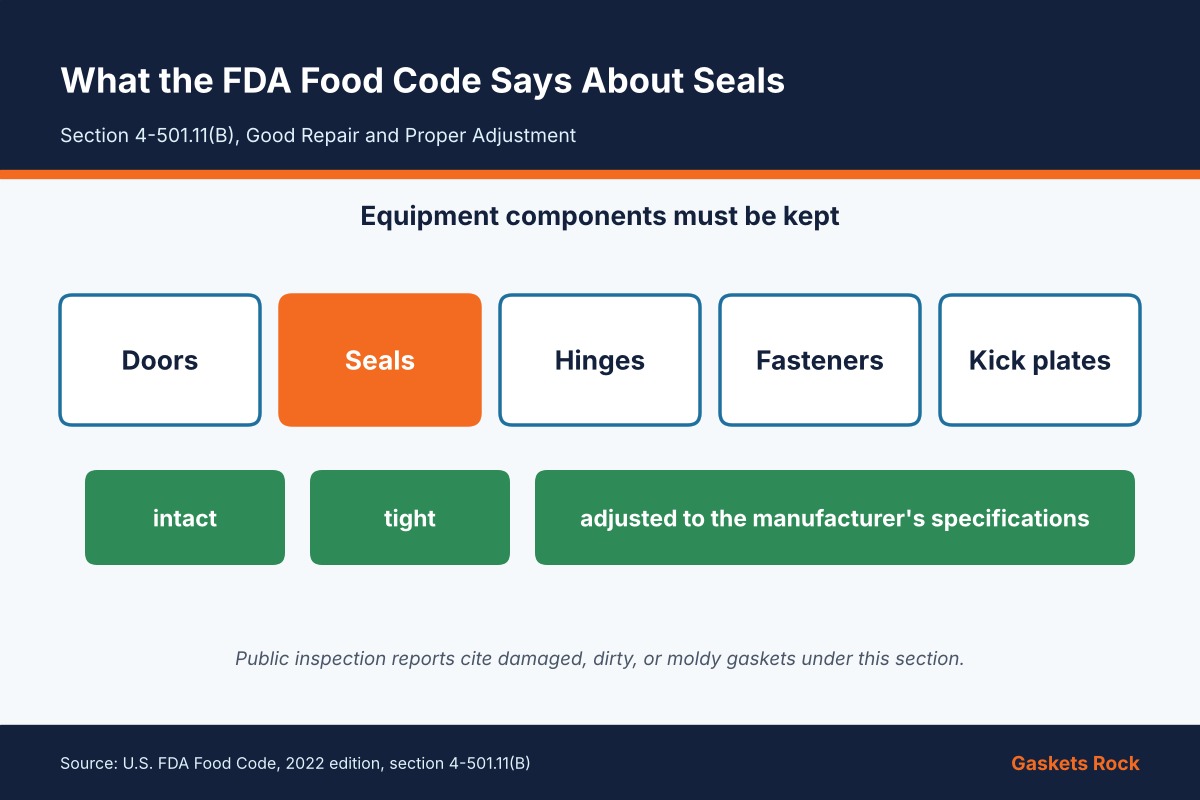
State and local health departments enforce their own adopted version of the code, and public inspection reports show gaskets cited as damaged, dirty, or moldy under this section. A fresh, well-fitted seal is one of the lowest-cost ways to remove that finding from your next inspection.
How Do You Make Commercial Freezer Gaskets Last Longer?
Clean the gasket regularly, keep the door aligned, and inspect the seal on a set schedule. Small habits slow wear on every commercial freezer door gasket:
- Wipe the gasket and its folds with mild soap and warm water, then dry. Avoid harsh abrasives that nick the rubber.
- Keep stock, carts, and cases from pinning the door open or crushing the seal.
- Repair sagging doors early so the gasket compresses evenly across the frame.
- Keep freezer strip curtains and door sweeps in good shape to reduce air movement across the doorway.
- Walk the seal at every shift change and log any frost or tears.
Kitchens that would rather not track this themselves can enroll in a scheduled gasket maintenance program, where seals are checked and replaced before they fail.
Repair or Replace a Walk-In Freezer Door Seal?
Clean or re-seat a gasket that is dirty or popped out of its channel, and replace one that is torn, hardened, flattened, or repeatedly moldy.
| Condition | Best fix |
|---|---|
| Dirty, no damage | Clean with mild soap and warm water, then dry |
| Popped out of the channel | Re-seat the dart or retainer and re-check the seal |
| Small tear or missing section | Replace the gasket, since a torn seal will not reseal reliably |
| Hardened or flattened | Replace, because the rubber has lost compression |
| Mold that returns after cleaning | Replace the gasket |
| Gasket looks fine but the door sags | Correct the door alignment first, then re-test the seal |
Freezer Gasket Service for Multi-Location Restaurants
Restaurant groups and franchises can standardize freezer gasket replacement across every kitchen through one supplier. Gaskets Rock’s multi-location gasket service for restaurant groups audits and labels each unit, so make, model, and gasket profiles are on record for future purchase and installation at every site.
Managing Partners handle the install locally, which keeps downtime short and lets a kitchen in Texas and one in Ontario run on the same seal standard.
Commercial Freezer Door Gasket FAQs
Choosing and ordering
What size gasket does my walk-in freezer door need? ▸
The right gasket depends on the profile (cross-section shape) and the length of your door perimeter, so size alone is not enough. Share the equipment make and model, or let Gaskets Rock audit the unit and record the gasket profile, so the replacement matches the door.
Are custom freezer door gaskets better than OEM? ▸
In Gaskets Rock’s experience, OEM seals are often not built for the constant use a restaurant freezer sees. Custom-fit seals are made from more robust, heat- and mold-resistant material and are matched to your door profile, which helps them hold a tight seal longer.
Which equipment brands can you match? ▸
Gaskets Rock replaces seals for many brands and manufacturers of walk-in and reach-in freezers. If your brand is not listed, send the make, model, and a photo of the existing gasket and a Managing Partner will confirm the match.
Are Gaskets Rock freezer gaskets safe for food storage areas? ▸
Yes. Gaskets Rock seals are free of lead, mercury, and cadmium, so they are suited to kitchens where food is stored and prepared.
Installation and timing
How long does commercial freezer gasket replacement take? ▸
Gaskets Rock teams typically produce and install a new seal in 3 to 7 days, depending on location. A free audit and unit labeling at the start of service records your make, model, and gasket profile for faster re-orders.
Can I replace a walk-in freezer door gasket myself? ▸
A simple push-in swap is possible, but a wrong profile or a few inches of mismatch leaves gaps that leak air. A professional install also checks door alignment, hinges, and the latch, which are common reasons a new gasket still fails to seal.
Why is ice forming around my freezer door? ▸
Ice at the frame usually means warm, humid air is leaking through a worn or loose gasket and freezing at the edge. A misaligned door or a door frame heater that has stopped working can cause the same symptom, so inspect all three.
Food safety and inspections
What temperature should a commercial freezer hold? ▸
Frozen food should be stored at 0°F or below, according to USDA Food Safety and Inspection Service guidance. A gasket that leaks warm air makes that target harder to hold, especially during busy service.
Can a bad freezer gasket cause a health code violation? ▸
It can. Section 4-501.11(B) of the FDA Food Code requires doors, seals, hinges, and other equipment components to be kept intact, tight, and adjusted to the manufacturer’s specifications. Local health departments enforce their own adopted version, so check your jurisdiction.
Get Commercial Freezer Door Gaskets Matched to Your Equipment
Send us your freezer make and model and we will return a custom-fit seal quote built around your door profile. You can request a free quote in minutes.
Prefer to ask questions first? talk with a Managing Partner about your freezer, your timeline, or a multi-location order.