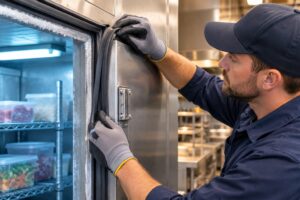
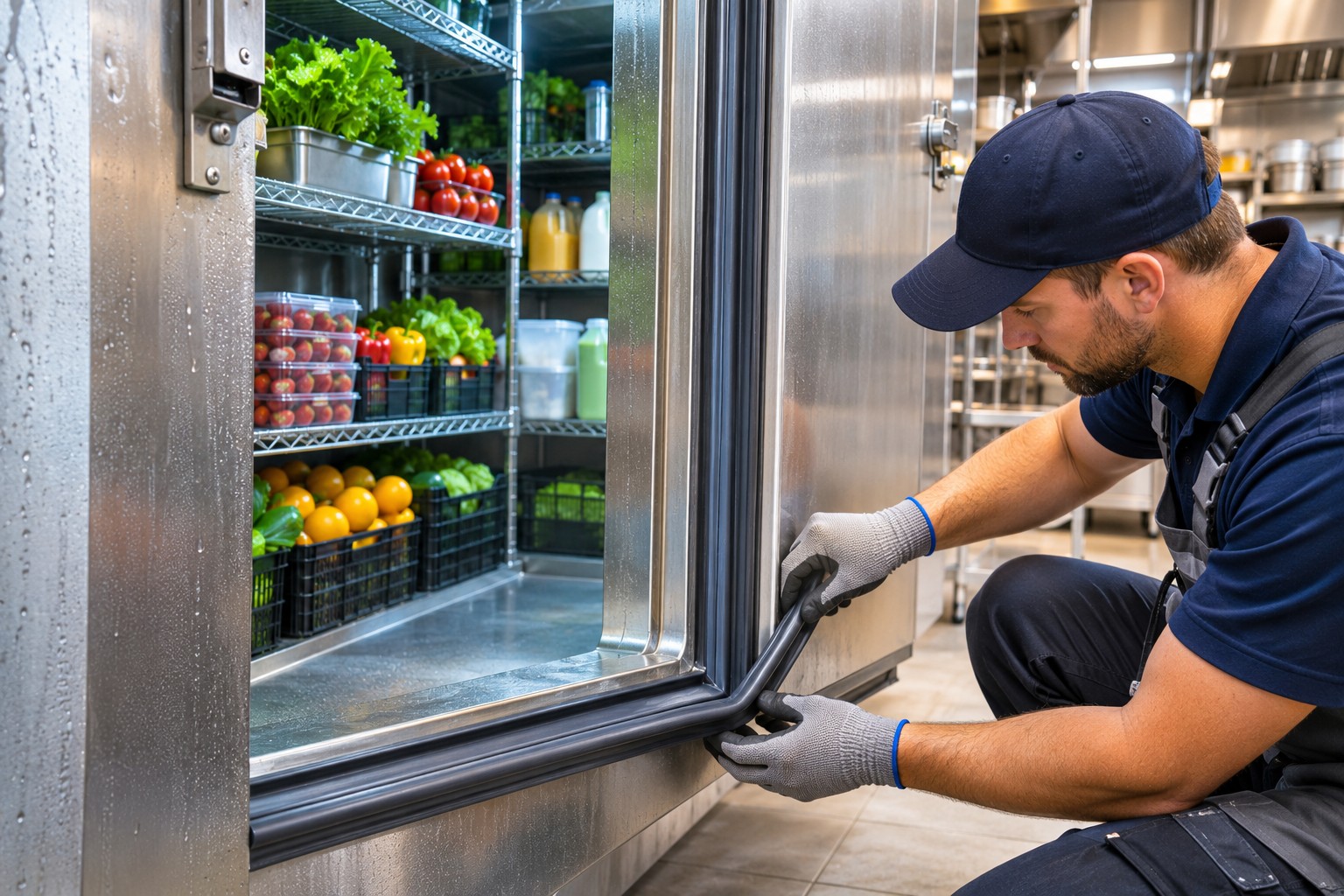
Well-fitted commercial cooler door gaskets keep a walk-in at a safe cold-holding temperature without the compressor running nonstop. The gasket is a small strip that shuts out the heat and grease of a working kitchen, and when it fails, temperature swings, spoiled stock, and repair calls follow. Gaskets Rock produces custom-fit cooler gaskets for a wide range of brands and installs them through Managing Partners across the United States, Canada, and Mexico, typically in 3 to 7 days.
What Do Commercial Cooler Door Gaskets Do for a Walk-In?
Commercial cooler door gaskets form an airtight seal between a walk-in cooler door and its frame, blocking warm, greasy kitchen air and holding cold air inside so food stays at a safe temperature.
The gasket is one of the smallest parts on the unit, yet it decides how hard everything else has to work. When the seal holds, the compressor cycles normally. When it leaks, the cooler spends its day catching up, and the first people to notice are usually the inspector and the person reordering spoiled product.
Is It the Gasket or the Compressor? Four Quick Checks
Suspect the gasket when the compressor runs nonstop, the cooler struggles to hold temperature, food spoils early, or maintenance calls keep coming back, because all four can trace to warm air leaking in. Ask whether your cooler:
- Has a compressor that runs without cycling off.
- Needs repeated maintenance for the same cold-holding complaints.
- Struggles to hold the correct temperature, especially in the afternoon rush.
- Spoils food early, leading to waste and higher grocery bills.
Two or more yes answers point toward the door seal. A technician should still confirm refrigerant, coils, and the door before ordering, but the door seal is one of the fastest things to rule in or out first.
Cooler vs Freezer Door Gaskets: What Is Different?
Cooler and freezer gaskets do the same job at different temperatures, so they fail in different ways. Coolers tend to show moisture, mold, and condensation, while freezers show frost and ice at the frame.
| Factor | Walk-in cooler | Walk-in freezer |
|---|---|---|
| Cold-holding target | 41°F (5°C) or less for TCS food (FDA Food Code) | 0°F or below for frozen storage (USDA guidance) |
| Typical failure symptom | Condensation, damp folds, and mold | Frost and ice along the frame |
| Main material demand | Resistance to heat, grease, and mold | Flexibility that holds up at sub-zero temperatures |
| Cleaning exposure | Frequent wipe-downs around a wet seal | Less moisture, but ice can tear the seal when forced |
Kitchens that run both can order together. Gaskets Rock’s free audit covers every refrigeration unit, including the walk-in freezer seal installation service, so one visit records every profile.
Why Do Walk-In Cooler Door Gaskets Fail?
Walk-in cooler door gaskets fail from constant door cycling, heat and grease from the cooking line, harsh cleaners, trapped moisture that grows mold, and misaligned doors that pinch the seal unevenly.
- Door cycling: every open and close compresses the seal, and low-grade rubber stops rebounding.
- Heat and grease: radiant heat hardens the gasket while grease softens and stains it.
- Moisture: damp folds hold mold that cleaning cannot always remove.
- Cleaning chemicals: harsh products dry out and crack the surface.
- Door alignment: sagging hinges and handles compress one corner and leave a gap at the other.
Heat, Grease, and Mold: What a Kitchen Gasket Must Survive
A commercial kitchen gasket has to survive heat, grease, moisture, and thousands of door cycles, and keep sealing through all of it. That is the standard Gaskets Rock builds to, and the reason why customers switch to custom-fit gaskets after one OEM failure too many.
| Kitchen stress | What the gasket needs |
|---|---|
| Heat from the cooking line | A heat-resistant compound that does not harden or warp |
| Grease | A surface that wipes clean instead of absorbing residue |
| Moisture and condensation | Mold-resistant material in the folds |
| Daily door cycling | Compression recovery so the seal springs back |
| Food storage areas | Material free of lead, mercury, and cadmium |
Gaskets Rock cooler gaskets are available in modern shades of grey and black, so a durable seal does not have to look out of place.
Which Commercial Cooler Door Gasket Fits Your Door?
Most walk-in cooler gaskets are push-in (dart), screw-in, or magnetic profiles, and the right one is set by your door’s make, model, and gasket profile, not just its size. Gaskets Rock supplies gaskets for all of your cold-storage equipment in every common profile.
| Profile style | Where it is common | What to confirm before ordering |
|---|---|---|
| Push-in (dart) | Doors with a groove in the door or frame | Dart width and depth |
| Screw-in (retainer) | Heavy-duty doors with a retainer strip | Retainer style and screw spacing |
| Magnetic | Reach-in units and some walk-in doors | Magnet strength and steel contact surface |
| Bottom door sweep | The floor gap on walk-in doors | Sweep length, plus door sweeps and closers for the full seal |
How to Measure for Commercial Cooler Door Gaskets
Measure the existing seal path, identify how it mounts, and record the equipment make and model before you order. A correct measurement avoids the gaps that a close-but-wrong gasket leaves.
- Read the make and model from the data plate. Gaskets Rock matches many of the equipment brands we service.
- Measure the height and width of the gasket path around the door.
- Identify the mounting style: dart, screw-in retainer, or magnetic.
- Note the corners and any cutouts for latches or hardware.
- Choose grey or black, then send the details, or let Gaskets Rock audit the unit at no charge.
What Temperature Must a Walk-In Cooler Hold?
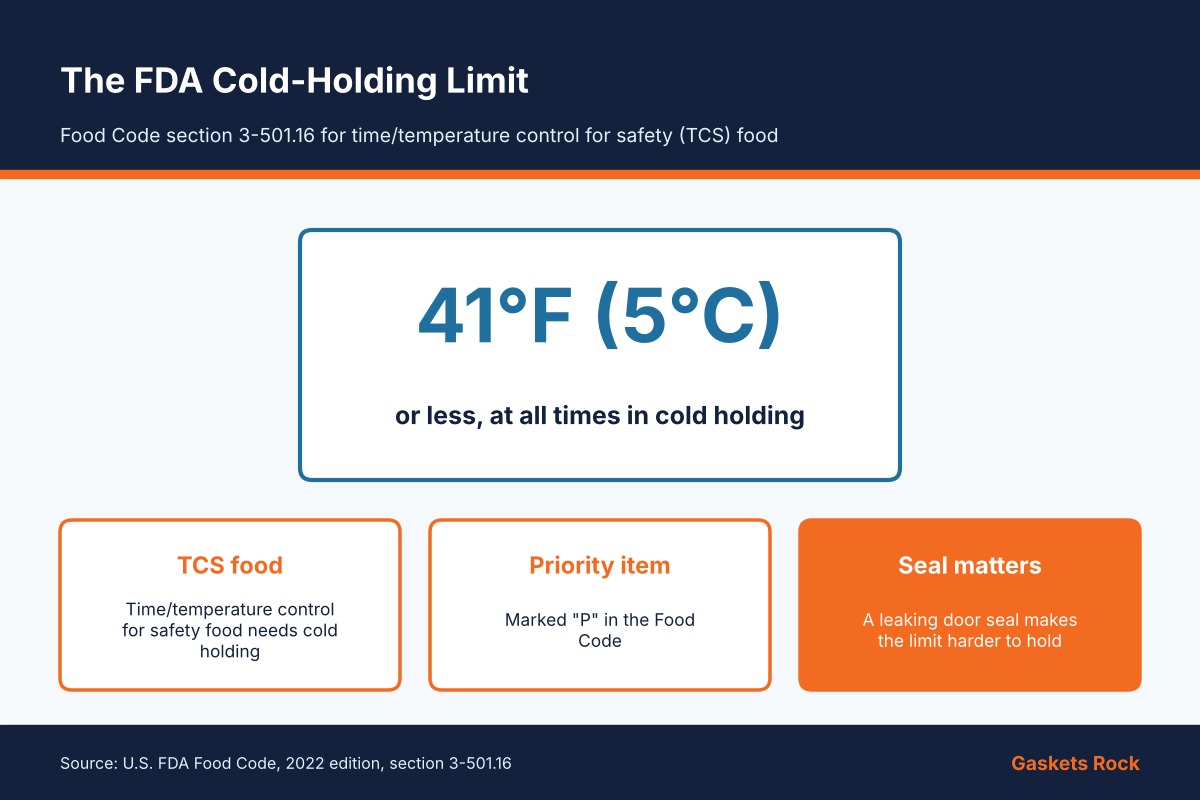
A walk-in cooler must keep time/temperature control for safety (TCS) food at 41°F (5°C) or less under the FDA Food Code, and USDA advises keeping cold food at or below 40°F.
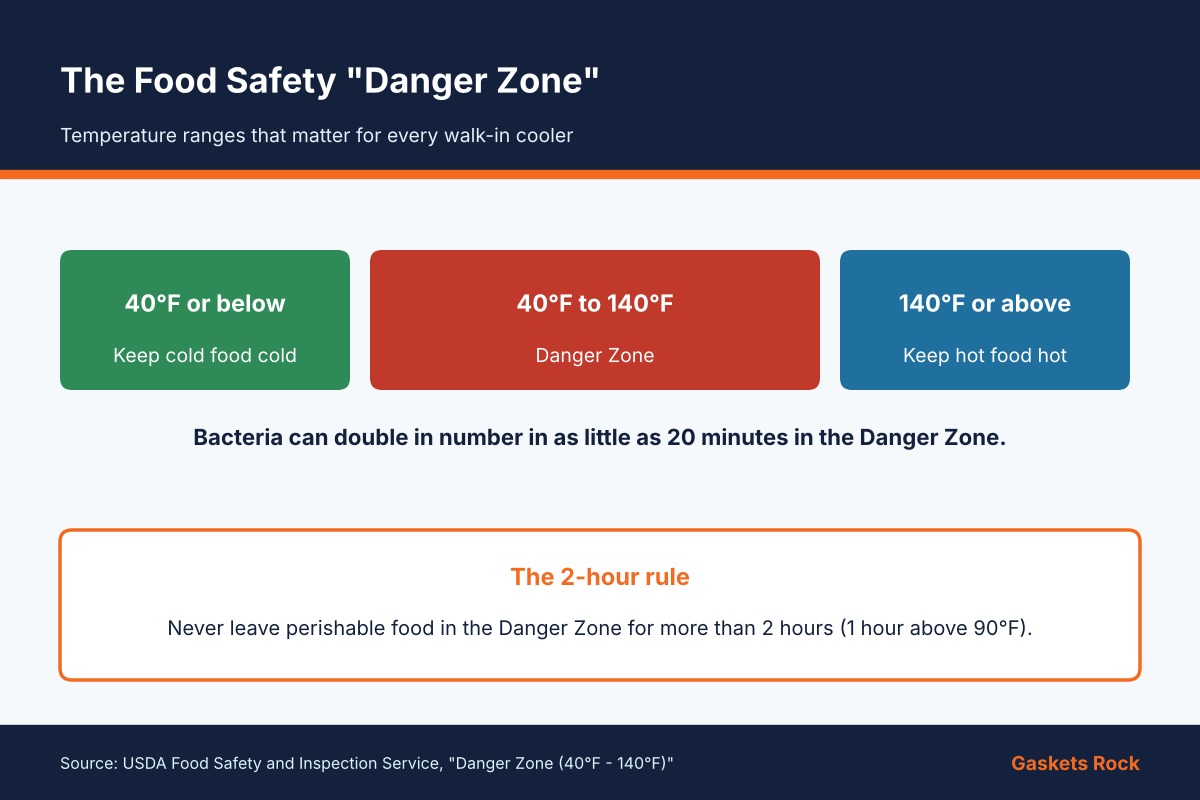
The reason is bacterial growth. USDA identifies 40°F to 140°F as the Danger Zone, where bacteria can double in as little as 20 minutes, and perishable food should not stay in that range for more than 2 hours.
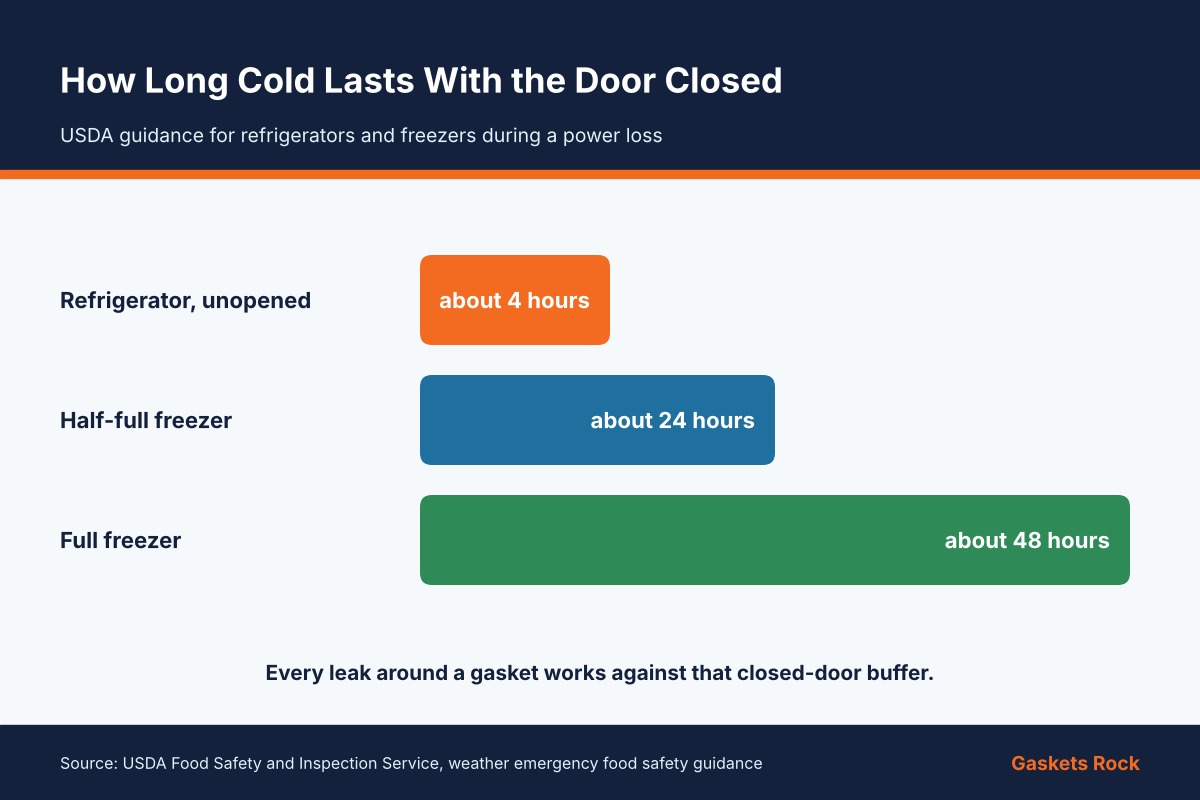
A leaking gasket lets the box drift toward that range, and the effect is worst during busy service when the door is opening constantly. USDA’s closed-door guidance shows how much the seal matters: an unopened refrigerator holds safe cold for about 4 hours after power loss, and freezers hold far longer, but only while the door stays closed and sealed.
How Custom Cooler Gasket Production and Installation Works
Custom production and installation takes 3 to 7 days from start to finish, depending on your location. Gaskets Rock’s gasket service for every cooler and freezer in your kitchen follows a set sequence so every unit ends up with a matched seal.
| Step | What happens |
|---|---|
| 1. Free audit | A Managing Partner reviews each unit, its appliance specifications, nearby equipment, and external temperatures |
| 2. Labeling | Every refrigeration unit is labeled at no charge, and make, model, and gasket profile go on record |
| 3. Custom production | The gasket is made to match the recorded profile and your kitchen conditions |
| 4. Installation | Your local Managing Partner installs the new seal, typically within 3 to 7 days of starting |
| 5. Quarterly inspections | Seals are checked for wear and tear after the install |
See the full walk-in cooler installation service for coverage details, and use the same record to reorder when a seal wears out.
Quarterly Gasket Inspections: What Gets Checked
A quarterly inspection checks compression, corners, mold, and door alignment, so a worn gasket is replaced before it affects cold holding. A good check covers:
- Compression and rebound along the full seal.
- Tears, splits, and lifted sections, especially at the corners.
- Mold or staining in the folds.
- Door alignment, latch pressure, and sweep condition.
- Condition of strip curtains that cut air movement across a busy doorway.
Operators who want the checks handled for them can join a scheduled gasket maintenance program instead of tracking it internally.
Commercial Cooler Gaskets for Restaurants and Multi-Location Operators
High-volume restaurants have little room for equipment failures, so a standard gasket spec across every kitchen saves time. Gaskets Rock runs a multi-location gasket service for restaurant groups that records each unit’s make, model, and gasket profile.
Gaskets Rock is headquartered in Pittsburgh, Pennsylvania, with Managing Partners across the United States, Canada, and Mexico. Find the Managing Partner nearest you for local installation.
Commercial Cooler Door Gasket FAQs
Fit and materials
Can you replace gaskets on my brand of walk-in cooler? ▸
Gaskets Rock installs and replaces commercial refrigerator door gaskets and walk-in cooler gaskets for a wide range of brands. Send the make and model, or let a Managing Partner audit the unit and record the gasket profile.
What colors do commercial cooler door gaskets come in? ▸
Gaskets Rock gaskets are available in modern shades of grey and black, so the seal blends in with your equipment.
How are Gaskets Rock cooler gaskets different from OEM? ▸
In Gaskets Rock’s experience, OEM seals are often not robust enough for a commercial kitchen where temperatures fluctuate. Gaskets Rock seals resist heat, grease, and mold, use more durable materials, and are free of lead, mercury, and cadmium.
Service and timing
How long does walk-in cooler gasket replacement take? ▸
From production to installation, the process takes 3 to 7 days, depending on your location.
Do you check the gaskets after installation? ▸
Yes. Gaskets Rock offers quarterly inspections that check for wear and tear, so a seal is caught before it fails.
Can you handle several restaurant locations at once? ▸
Yes. Managing Partners across the United States, Canada, and Mexico handle installs locally, and the free audit records each unit’s make, model, and gasket profile for future orders.
Temperature and inspections
What temperature should a walk-in cooler hold? ▸
Under the FDA Food Code, time/temperature control for safety food must be held cold at 41°F (5°C) or less. USDA advises keeping cold food at or below 40°F.
Why is my walk-in cooler door sweating or leaking water? ▸
Warm, humid air meeting cold surfaces creates condensation. A worn gasket, a misaligned door, or a missing sweep lets that air in, so inspect all three.
Can a worn cooler gasket cause a failed inspection? ▸
It can. A torn or loose seal can be cited under Food Code section 4-501.11(B), which requires seals and doors to be kept intact and tight, and a cooler that cannot hold 41°F risks a cold-holding violation under section 3-501.16.
Start Your Cooler Gasket Audit
Tell us which coolers are giving you trouble and we will size a custom seal around your equipment. You can request a free quote in minutes.
Have a question about timing, brands, or a multi-site order? talk with a Managing Partner directly.