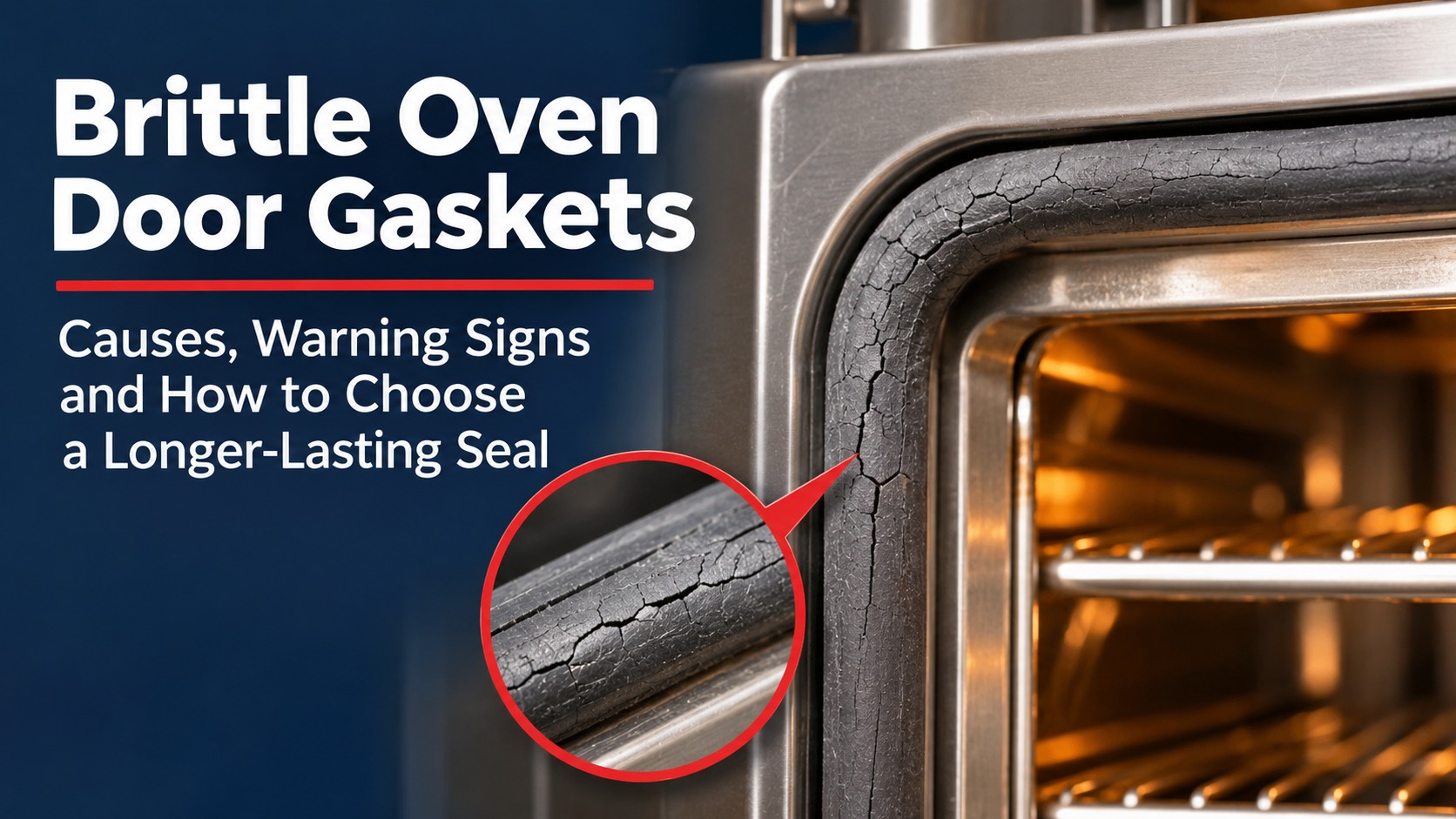
Brittle oven door gaskets are what you get when a seal spends months or years swinging between a cool kitchen and a hot cooking cavity. The rubber loses its flexibility, stops springing back when the door closes, and eventually cracks. If you are replacing seals every couple of months, the real problem is rarely how often you swap them. It is usually the material and the fit.
A hardened seal is more than a cosmetic flaw. Heat leaks into a kitchen your cooling system is already fighting, burners and elements run longer to make up the difference, and cold spots near the door can put food temperatures at risk. This guide explains why oven seals harden, how to spot the early signs, what the failure costs, and how to choose a replacement that holds up in a working kitchen.
Why Brittle Oven Door Gaskets Develop Over Time
A commercial oven door seal has one job: keep heat inside the cooking cavity and keep cooler room air out. It does that job every minute the oven is on, which means it is exposed to more thermal stress than almost any other part of the unit. Unlike a burner or a thermostat, a gasket gives few warnings before it stops working. It simply gets a little stiffer with every cycle until it can no longer press evenly against the door frame.
How Heat Cycling Wears Down an Elastomer
Most oven and steamer gaskets are made from elastomers, rubber-like polymers held together by cross-linked molecular chains. Every time the oven reaches operating temperature and cools again, the seal expands and contracts. Over thousands of cycles, the chains change: some break, some bond to each other more tightly, and the material slowly loses the softness that let it conform to the door.
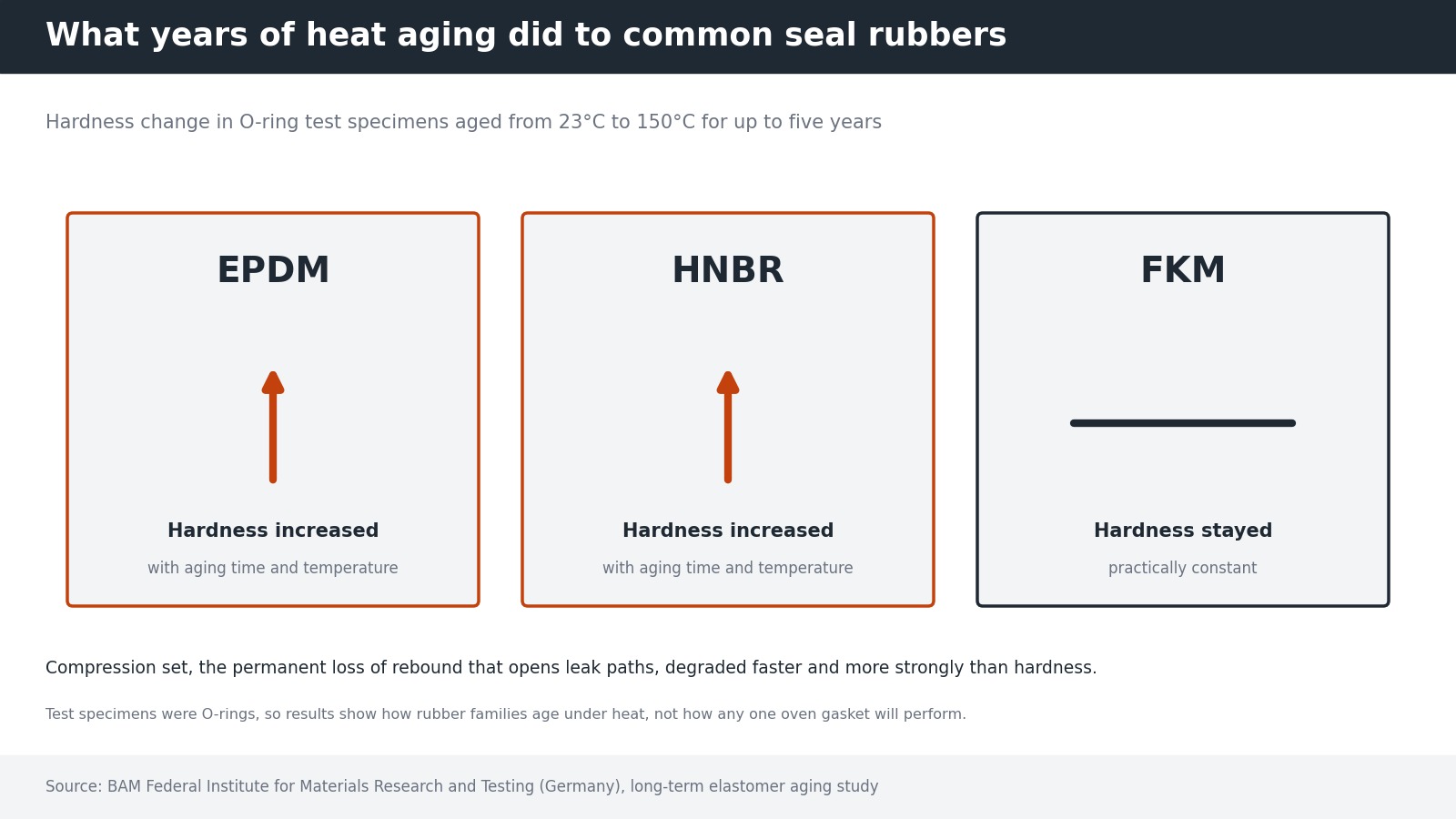
Long-term laboratory work backs this up. Germany’s BAM Federal Institute for Materials Research and Testing aged O-rings made of EPDM, HNBR, and FKM at temperatures from room temperature up to 150°C for as long as five years. Hardness rose with aging time and temperature for EPDM and HNBR, while FKM stayed practically constant. The researchers also found that compression set degraded faster and more strongly than hardness, which is why a seal can look acceptable and still leak.
Plasticizer Loss, Oxidation and Compression Set
Three separate processes work together to turn a soft seal into a stiff one:
- Plasticizer loss: the oils that keep a compound pliable evaporate under sustained heat, leaving a firmer, less forgiving material.
- Oxidation: heat and oxygen attack the surface, producing the fine surface cracks you see on an aging seal.
- Compression set: the seal takes a permanent flat spot where it is squeezed, so it no longer pushes back against the door when it closes.
Compression set is the one to watch. It measures how much permanent deformation remains after a seal has been compressed and heated, and it tracks closely with sealing performance. A seal with a high compression set still touches the door but no longer presses hard enough to block air.
Why the Damage Stays Hidden Until a Crack Appears
Degradation is gradual. A gasket does not fail overnight, and it loses a little sealing force with every service cycle. By the time a crack is visible, the seal has usually been leaking for weeks. Kitchens that wait for a visible failure are replacing parts that stopped performing long before.
Warning Signs of a Failing Commercial Oven Gasket
Catching a failing seal early saves energy and prevents the cold spots that cause uneven cooking. Most of the signs show up in the seal itself, in the oven’s performance, and in the surrounding kitchen.
What Brittle Oven Door Gaskets Look Like in a Working Kitchen
| Sign | What you see | What it means |
|---|---|---|
| Surface cracks | Fine splits or checking along the face of the seal | Oxidation has reached the surface and flexibility is gone |
| Hard, flat sections | Areas that feel stiff and do not rebound when pressed | High compression set, so the seal is no longer pressing against the door |
| Gaps at corners | Light or heat visible where the seal meets the frame | The seal has shrunk or deformed and leaks at the weakest points |
| Heat or steam at the door edge | Warm air or vapor escaping around the perimeter | An active leak is wasting energy and heating the kitchen |
| Uneven cooking | Browning differences or longer cook times near the door | Cold air is entering the cavity and creating temperature gradients |
| Loose or missing sections | Pieces pulling out of the channel or hanging free | The seal has shrunk and lost its grip on the door |
A Five-Minute Door Seal Check
With the oven cold and off, a short walk-around inspection tells you most of what you need to know:
- Run a gloved finger along the full seal and note any stiff, flat, or cracked sections.
- Close a strip of paper in the door at several points around the perimeter and pull it out. Little or no resistance means the seal is not pressing.
- Check the corners and the bottom edge, where heat and grease build up first.
- Look at the channel or mounting edge for loose, shrunken, or missing sections.
- Open and close the door and watch for sagging or misalignment that points to worn door hinges and handles.
What a Leaking Oven Seal Costs Your Kitchen
A cracked seal is not a one-time loss. It leaks every hour the oven is on, and the costs show up in your utility bill, your cooling load, and your inspection results.
Wasted Energy and a Hotter Kitchen
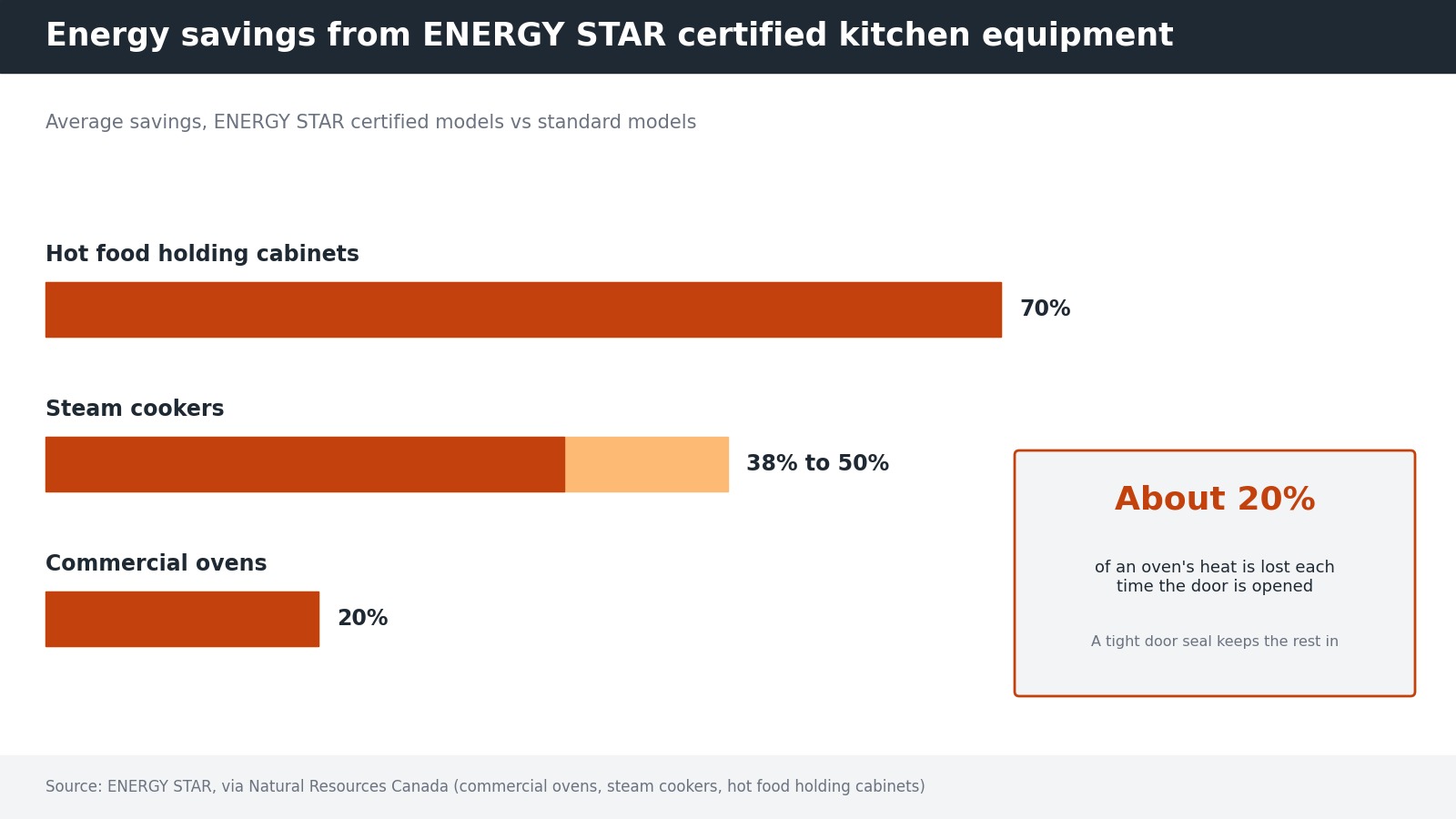
ENERGY STAR guidance, as published by Natural Resources Canada, tells operators to make sure the oven door seal is tight because a loose seal leaks heat and wastes energy. The same guidance notes that an oven loses roughly 20% of its heat whenever the door is opened, so a seal that gaps even when the door is closed adds a constant loss on top of the one operators already manage. ENERGY STAR certified commercial ovens use about 20% less energy on average than standard models, and the guidance lists improved gaskets among the features behind that performance.
Escaping heat also lands in your dining room and prep area. Every degree that leaks from an oven door is heat your air conditioning has to remove, so you pay for it twice: once to create it and again to cool it. In warmer climates, and during summer service everywhere, that double cost is easy to miss because it hides inside a general rise in utility spend.
Food Safety and Inspection Exposure
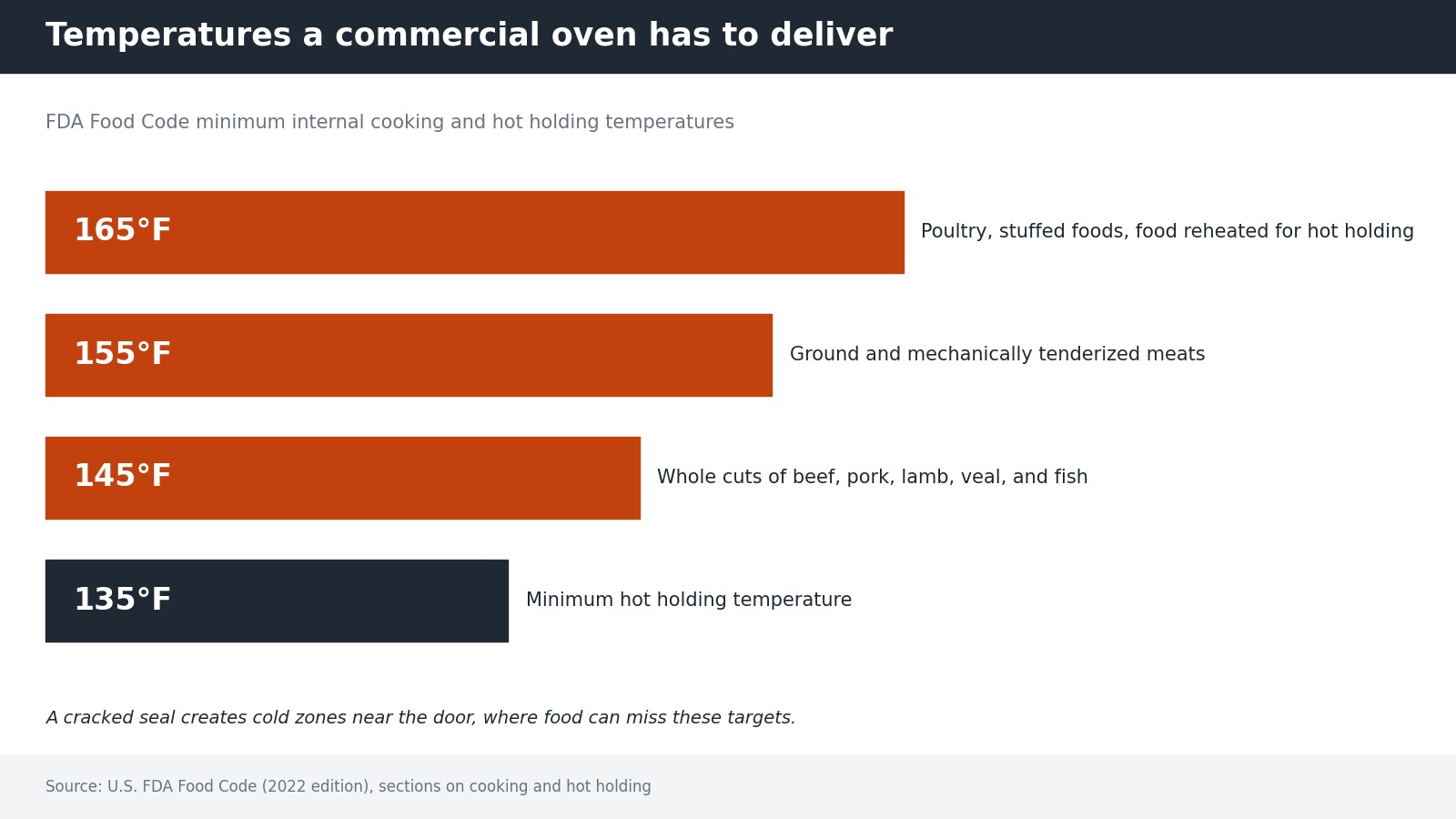
Many health inspectors work from the FDA Food Code, a model code that FDA reports has been widely adopted by state, local, tribal, and territorial agencies. It sets minimum internal temperatures for cooked food, including 165°F for poultry and 145°F for whole cuts of beef, pork, lamb, and veal, and it requires hot food to be held at 135°F or above.
Cold Zones Near the Door
A seal that lets room air into the cavity can create cooler areas near the door. Food placed there may cook more slowly than the controls suggest, which makes temperature checks harder to trust. The oven may read correctly at the thermostat while the product closest to the leak falls short, and a glance at the door seal alone will not reveal it.
Oven Gaskets vs Steamer Gaskets: Two Different Failure Modes
Dry-heat ovens and steamers both rely on a tight door seal, but they stress the seal in different ways. Choosing a replacement without accounting for that difference is a common reason new gaskets fail early.
| Equipment | Main stress on the seal | Common failure signs | What to look for in a replacement |
|---|---|---|---|
| Convection and deck ovens | Sustained dry heat and repeated heat-up and cool-down cycles | Hardening, cracking, flat spots, shrinking | A compound made for continuous high heat and a profile cut for your exact door |
| Combi and steam cookers | Heat combined with constant moisture | Softening, swelling, tackiness, hardening | A compound that handles steam and heat together, matched to the model |
| Hot holding cabinets | Lower heat, frequent door use | Torn or loose sections, weak closure | A full-perimeter seal in good condition, often with a magnetic closure |
Dry Heat in Convection and Deck Ovens
In a dry-heat oven, the main enemy is thermal aging. The seal bakes slowly, loses its oils, and stiffens. The failure pattern is cracking, flattening, and shrinking, usually starting at the corners and along the bottom edge where grease and heat concentrate. Because the seal is working against the same heat load all day, a compound that is only rated for light-duty use will age much faster than one made for continuous service, such as custom gaskets for commercial ovens and steamers.
Wet Heat in Steamers
Steamers add moisture on top of heat, and operators often see a different pattern: seals that swell, soften, or turn tacky alongside hardening. The stakes are high because the seal is central to how the unit performs. ENERGY STAR certified commercial steam cookers are up to 60 percent more energy efficient than standard models, and the agency credits better insulation and more efficient steam delivery with reduced heat loss. Natural Resources Canada’s steam cooker guidance also tells operators to keep the door firmly shut while the unit runs. A worn steamer seal works against every one of those design gains.
Why a Refrigeration Gasket Cannot Seal a Hot Oven
It is tempting to treat all gaskets as interchangeable, especially when a unit is down and a refrigeration seal is on the shelf. It is a mistake that costs more than the part. Refrigeration gaskets are built for cold-side sealing, where the job is to keep warm room air out of a chilled cavity. They are not designed for the sustained heat of a commercial oven, and they can soften, deform, or harden quickly under it.
The principle is the same on both sides of the kitchen: a tight perimeter seal protects efficiency. The materials are not. Cold-side equipment needs a seal engineered for cold, condensation, and frequent door use, and our cold-side gasket service covers that side of the line. Hot-side equipment needs a seal made for heat, grease, and in the case of steamers, moisture. Even hot food holding cabinets, which run well below oven temperatures, are often fitted with magnetic door gaskets, and ENERGY STAR advises keeping those gaskets and automatic closers in good working order.
How to Stop Replacing Oven Gaskets Every Few Months
If your seals are crumbling within a season, swapping them more often will not fix it. The fix is changing what you install and how you maintain it.
Match the Material to the Equipment
OEM seals are often built to a price point, and generic retail replacements are usually designed for lighter use than a restaurant puts them through. A home oven might cycle a few times a week, while a commercial unit can run through that many cycles in one shift. Seals made for the lighter duty cycle fail faster, not because they were defective, but because they were never meant for the load. Gaskets Rock builds the toughest gaskets on the planet by custom-fitting each one to your exact oven or steamer model and using materials formulated for heat, grease, and moisture.
Build a Simple Inspection Routine
- Check door seals at the start of each week, and after any deep cleaning with strong chemicals.
- Photograph cracks and flat spots so changes are easy to track.
- Replace seals when they harden or gap, instead of waiting for a visible tear.
- Keep a spare, correctly sized seal on site for each critical oven or steamer.
- Log replacement dates so you can see whether a new material actually lasts longer.
- Confirm each oven and steamer model against the equipment brands we service before you order.
For kitchens that would rather not manage this in-house, a recurring gasket maintenance program puts inspection and replacement on a schedule so seals are swapped before they leak.
Fix the Door Hardware at the Same Time
A new seal cannot compensate for a door that hangs crooked or closes unevenly. Worn hinges, loose handles, and failing closers change how the door meets the seal and cause uneven wear, so a fresh gasket can fail early on one side. Inspect the hinges and handles whenever you replace a seal, and review door sweeps and closures on any walk-in or reach-in equipment that shares the kitchen.
Get Help From a Specialist Who Knows Your Equipment
The fastest route is a partner who can assess your equipment on site and fit the right seal without you hunting for make and model numbers. Operators across the United States, Canada, and México work with a local managing partner for that kind of hands-on service.
Operators running several locations can also standardize seal specifications across every kitchen, which is how multi-unit and franchise kitchens keep replacement costs predictable.
“I really appreciate Gaskets Rock and especially Ted Stepp, out of KY and WV. We’ve been partnered together for over a year with my Sonic Drive-In market. Their product: these are the strongest, easiest to clean, and longest lasting gaskets I’ve seen in my 30+ years in Food Service.”
John Dollar
Frequently Asked Questions About Oven Door Gaskets
Why do oven door gaskets become brittle? ▸
Repeated heat cycling is the main cause. Each time the oven heats up and cools down, the seal expands and contracts. Over months, heat drives out the oils that keep the rubber soft, oxidation attacks the surface, and the material stiffens until it cracks. Grease, cleaning chemicals, and constant door use speed the process.
How do I know if my oven door gasket is brittle? ▸
Look for cracks, flattened or hardened sections, gaps at the corners, and a seal that no longer springs back when pressed. You may also see heat or steam escaping around the door edge, uneven browning, longer cook times, or a kitchen that feels hotter than usual near the oven.
Can I use a refrigerator gasket on a commercial oven? ▸
No. Refrigeration gaskets are made for cold-side sealing and are not designed for sustained oven heat. They can soften, deform, or harden quickly when exposed to oven temperatures. Hot-side equipment needs a gasket made and fitted for the heat, grease, and moisture of that specific oven or steamer.
How much energy does a leaking oven door waste? ▸
The exact figure depends on the oven, the damage, and how often it runs. ENERGY STAR advises operators to keep the oven door seal tight because a loose seal leaks heat and wastes energy, and it notes that an oven loses roughly 20% of its heat whenever the door is opened. A cracked seal adds a constant leak on top of that.
How often should commercial oven gaskets be replaced? ▸
There is no single interval. High-volume kitchens that run several services a day wear seals faster than light-duty operations. Inspect seals on a regular schedule and replace them when you see hardening, cracking, or gaps, rather than waiting for a visible failure. A gasket made for your exact equipment and heat load will last longer between replacements.
Get an Oven Seal That Lasts
If your oven or steamer seal is overdue, stop paying for cheap fixes that fail in a season. contact our team at (800) 790-9284, Monday through Friday from 8:00 AM to 6:00 PM, or request a quote to get a seal matched to your equipment.