Ice forming on the walk-in floor. The compressor cycling without pause. A health inspector’s probe thermometer reading two degrees above safe. These symptoms rarely trace back to a failing refrigeration system. More often, they trace back to a single overlooked gap at the very bottom of the door, and the walk-in cooler door sweep that is supposed to close it.
Most operators who see these warning signs replace their three-sided door gasket and expect the problem to disappear. It doesn’t, because that floor-level gap is a completely separate failure point. A door sweep is the physical barrier at the threshold, stopping dense cold air from sliding out and blocking warm, humid kitchen air from rushing in to replace it. Stopping that leak means understanding how floor-level airflow behaves, how to spot a sweep that has already failed, and how to choose a replacement built for a working commercial kitchen.
The Physics Behind a Floor-Level Cold Air Leak
Cold air is heavy. It sinks to the floor of a walk-in cooler and pools there, creating a high-pressure zone at the bottom of the door. When that cold air finds a gap at the threshold, even a narrow one, it slides out across the kitchen floor. The pressure drop left behind creates a low-pressure zone near the top of the interior, and that vacuum actively pulls warm, humid kitchen air in through any available opening higher up. The cycle feeds itself: the more cold air escapes at the bottom, the harder the system works to pull warm air through the top. Sealing the floor gap with a properly fitted door sweep interrupts that cycle and restores the pressure balance that keeps cold air where it belongs.
The federal government has recognized this exact failure point for well over a decade. Since 2009, walk-in coolers and walk-in freezers manufactured for U.S. commercial use have been required to include strip doors, spring-hinged doors, or another method of minimizing infiltration whenever the main door is open, according to the U.S. Department of Energy’s walk-in cooler and freezer energy conservation standards. That rule targets the open-door moment, but it underscores a point that applies just as directly to the closed-door threshold: any uncontrolled gap at floor level works against the entire refrigeration system, not just the corner of the kitchen closest to the door.
A three-sided gasket creates a false sense of security for a lot of operators. Gaskets seal the top and two vertical sides of the door frame through magnetic compression, but they were never designed to interact with the floor. The bottom of the door is a different environment entirely. It swings through an arc, contacts a threshold that collects grease, grit, and cleaning chemical residue, and takes the brunt of foot traffic every time someone enters or exits. A worn or missing sweep at that threshold forces the refrigeration system to constantly make up for the warm air pouring in, which drives up utility costs and puts unnecessary strain on the compressor over time.
Signs Your Walk-In Cooler Door Sweep Is Failing
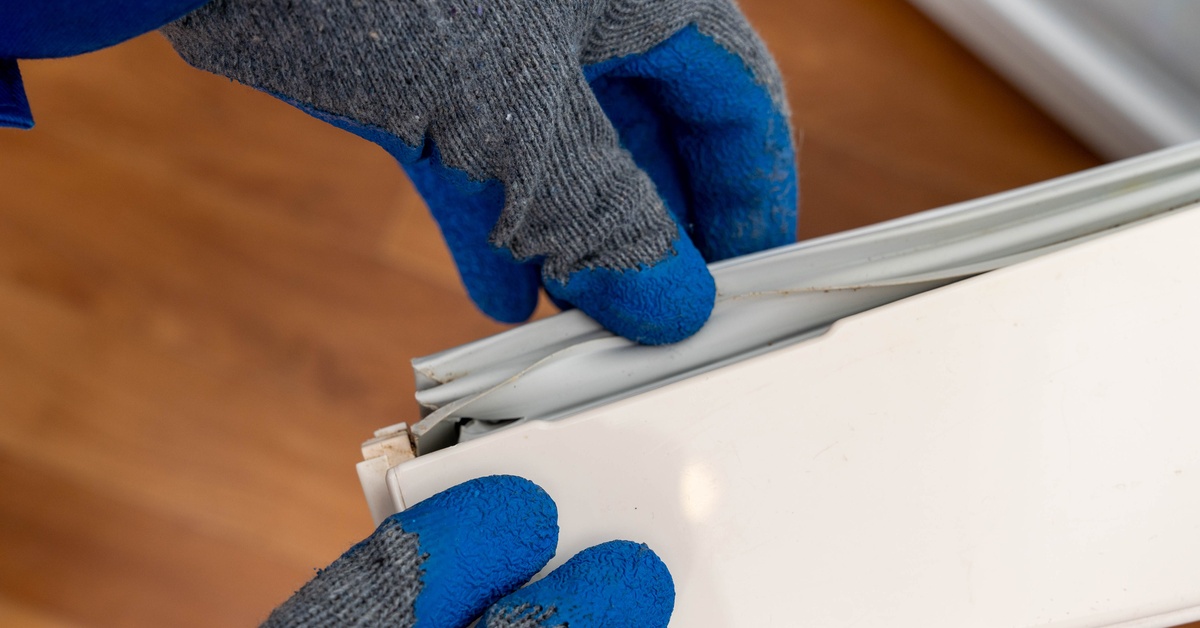
The first check requires no tools. Close the walk-in door completely and crouch down at floor level. If light is visible under the door, air is moving through that gap freely, and a cold draft at ankle height near the entrance confirms it. Physical degradation on the sweep itself is usually just as obvious: cracking along the rubber edge, tearing at the mounting points, or a stiffness that keeps the sweep from following the threshold. Grease, heavy foot traffic, and the caustic cleaning chemicals common in commercial kitchens accelerate that wear on cheaper materials. A sweep that drags audibly on the floor is also a problem. It is either mounted too low, which chews through the rubber quickly, or it has sagged out of alignment, and either way it will not hold the seal for much longer.
Testing Your Walk-In Cooler Door Sweep in Two Minutes
What You Will Need
A flashlight and a few minutes at the end of a shift are enough to run this check on every walk-in door in the building.
- Close the door fully and turn off the overhead kitchen lights near the threshold if possible.
- Crouch down and look along the full width of the bottom edge for daylight or reflected light.
- Run a flat hand slowly along the threshold at floor level, feeling for a steady cold draft.
- Open and close the door once, listening for scraping or dragging instead of a smooth, quiet swing.
- Note any cracking, curling, or gaps in the rubber for your maintenance log.
Frost accumulation near the doorway or on the evaporator coils is a reliable downstream indicator of warm air infiltration. Humid kitchen air hitting the freezing interior condenses and freezes on contact, so ice on the floor near the door is a direct record of how much warm air has been getting in. Temperature instability is another signal. If the cooler struggles to hold food-safe readings, or if the temperature climbs noticeably every time the door closes, the sweep is likely failing to retain cold air during those transitions. Every additional hour the compressor runs to recover that lost temperature is an avoidable line item on the utility bill, and it puts the walk-in closer to the range where a health inspector would flag it.
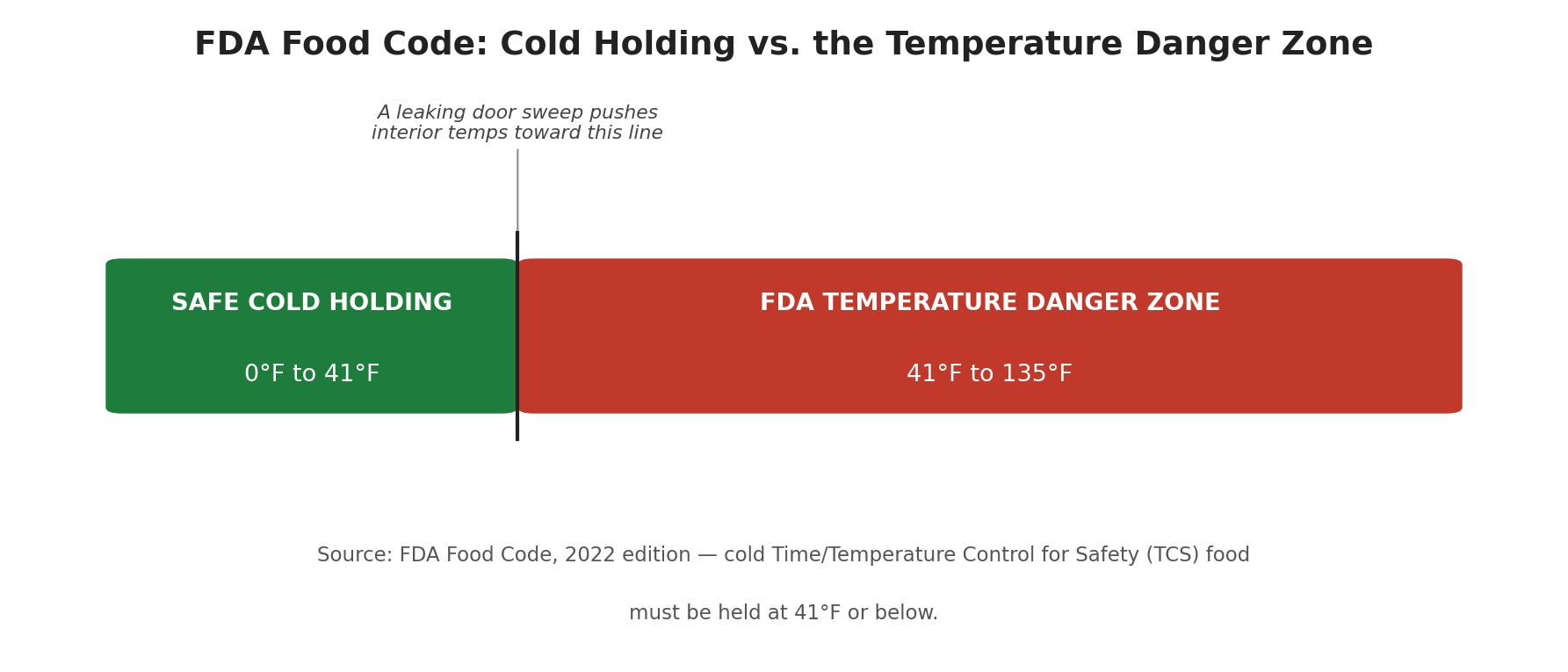
A walk-in cooler that cannot hold a stable temperature because of infiltration is one bad shift away from crossing into the danger zone shown above.
Source: FDA Food Code, 2022 edition, which requires cold Time/Temperature Control for Safety food to be held at 41°F or below.
“I really appreciate Gaskets Rock and especially Ted Stepp, out of KY and WV. We’ve been partnered together for over a year with my Sonic Drive-In market. Their product: these are the strongest, easiest to clean, and longest-lasting gaskets I’ve seen in my 30+ years in Food Service.” – John Dollar
- Visible light shining through the bottom of the door when it is fully closed.
- Cold drafts felt at floor level near the walk-in entrance.
- Cracked, torn, or stiff rubber on the sweep itself.
- Excessive frost or ice accumulating on the floor near the doorway or on the evaporator coils.
- A dragging or scraping sound when the door opens or closes, which points to improper clearance.
The Real Cost of a Leaking Door Sweep
A gap at the bottom of a walk-in door does not show up as its own line item on a utility bill, which is exactly why it goes unaddressed for so long. Instead, it shows up as a compressor that runs longer than it should, evaporator coils that need more frequent defrost cycles, and a refrigeration system working harder than its design was ever meant to require. Commercial refrigeration equipment already accounts for a meaningful share of a typical kitchen’s total energy draw, and infiltration at an unsealed threshold adds directly to that load every time the door is closed but not truly sealed.
Equipment efficiency programs back this up from the opposite direction. Commercial refrigerators and freezers that meet current efficiency criteria are built with high-efficiency compressors and tighter envelopes specifically because keeping warm air and heat out of the box, rather than simply adding more cooling capacity, is the more effective way to control energy use.
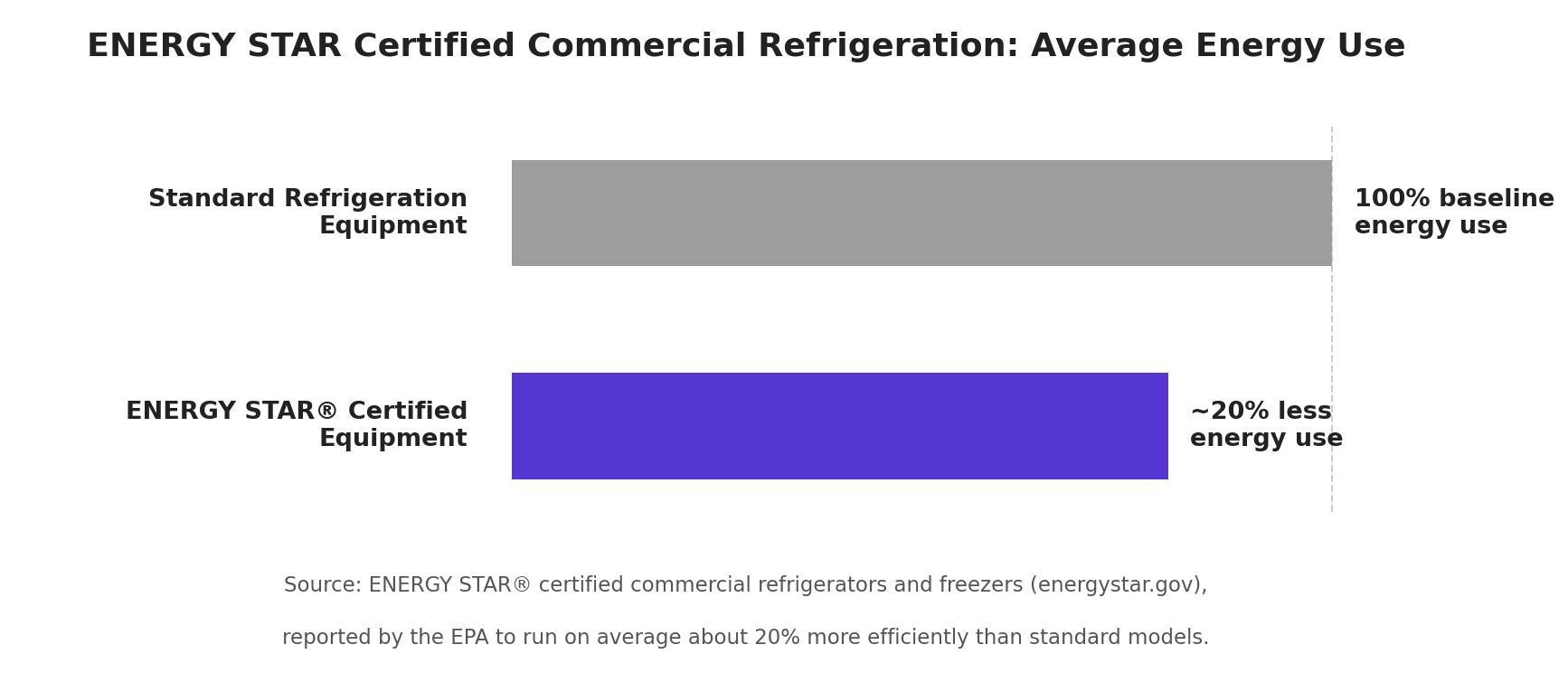
Source: ENERGY STAR certified commercial refrigerators and freezers, which the EPA reports run on average about 20 percent more efficiently than standard models.
That same logic applies to the door itself. A tight, well-fitted sweep is a low-cost way to protect the efficiency gains that better-sealed refrigeration equipment is designed to deliver. Professional installation typically runs between $45 and $120 per door depending on material, door type, and labor, and that cost tends to recover itself within a few months through reduced compressor runtime and lower utility use.
Cooler Gaskets vs. Door Sweeps: What Is the Difference?
Gaskets and sweeps are both critical to keeping a walk-in sealed, but treating them as interchangeable, or assuming one covers the other’s job, is where operators run into trouble. A magnetic door gasket uses compression against the metal door frame to seal the top and two vertical sides of the door. It never contacts the floor, it does not experience friction from foot traffic, and its failure mode is typically a loss of magnetic strength or compression over time. A door sweep operates in a fundamentally different environment: it slides across the floor threshold on every single door cycle, absorbing friction, grease, and abrasion that would destroy a gasket within days.
Because these two components wear at different rates and for different reasons, they need to be inspected on separate schedules. Replacing the gasket and assuming the sweep is fine, or the reverse, leaves a gap in the seal that shows up as frost, temperature drift, or a utility bill that keeps climbing. If you are already reviewing the top and side seal, our walk-in cooler gasket replacement service covers that half of the thermal envelope while a new sweep handles the floor.
Choosing the Right Sweep Material and Installation Method
The mechanical job of a door sweep sounds simple: bridge the gap between the door’s bottom edge and the floor threshold. Doing it well demands precision. The sweep has to maintain firm contact with the threshold to block airflow without dragging so hard that it tears away from the door or gouges the floor surface, and that balance depends almost entirely on material quality and correct installation height.
| Material | Cold Flexibility | Chemical Resistance | Typical Lifespan |
| Standard vinyl | Poor, stiffens and cracks below freezing | Low, degrades with grease and cleaners | 6 to 12 months in daily use |
| Food-safe silicone | Excellent through sub-zero cycling | High | Significantly longer than vinyl |
| Neoprene | Very good in cold storage | High | Significantly longer than vinyl |
Placement is determined by door swing direction. For in-swinging doors, which is the standard configuration on most commercial walk-in units, the sweep mounts on the interior face of the door. For out-swinging doors, it goes on the exterior. Installing it on the wrong face means the sweep gets driven into the door frame on every open cycle, which destroys it within weeks.
- Heavy-duty aluminum backing: Look for a rigid aluminum track that holds the rubber insert securely in place and prevents sagging over time.
- High-performance silicone or neoprene: Avoid cheap vinyl that cracks in the cold. Food-safe silicone or neoprene compounds keep their flexibility at sub-zero temperatures and resist the grease and cleaning chemicals that destroy standard sweeps.
- Proper clearance adjustment: The sweep needs enough contact to seal the gap without dragging heavily on the floor. Excessive drag accelerates rubber wear and can eventually pull the entire sweep off the door mounting.
- Fit with major brands: Choose sweeps designed to fit major walk-in manufacturers, including Amerikooler, Norlake, and Thermo Kool door configurations.
A DIY installation without accurate door measurements tends to produce clearance errors, which lead either to a dragging sweep that tears itself apart or a gap that defeats the purpose of installing one in the first place. Our door sweep and closure replacement service sends technicians directly to your facility to take measurements, identify exact makes and models, and install custom parts without you having to track down a single part number.
Seasonal Factors That Affect Door Sweep Performance
A sweep that seals well in January does not necessarily seal the same way in August. Rubber and vinyl compounds contract slightly in extreme cold and expand slightly in summer heat, and a kitchen with wide swings in ambient temperature between seasons puts more stress on a sweep’s clearance than one with stable year-round conditions. Humidity plays a role too. In warm, humid months, the air entering through a compromised threshold carries more moisture, which means more condensation and faster ice buildup on the floor and coils compared to the same leak in a dry winter kitchen.
Kitchen floors also shift slightly with seasonal temperature changes in the surrounding slab or subfloor, which can throw off a sweep’s clearance even if nothing about the door itself has changed. A sweep set perfectly in the spring may start dragging or gapping by late summer purely because the floor beneath it moved a fraction of an inch. Building a seasonal check into existing maintenance routines, rather than waiting for visible frost or a utility bill spike, catches that drift before it turns into a full seal failure.
Frequently Asked Questions About Walk-In Cooler Door Sweeps
What does a walk-in cooler door sweep actually do? ▸
A walk-in cooler door sweep is the strip of rubber or vinyl mounted along the bottom edge of the door that seals the gap between the door and the floor threshold. Because door gaskets only seal the top and two sides of the frame, the sweep is the only component blocking cold air from sliding out and warm, humid air from entering at floor level.
Are door sweeps installed on the inside or outside of a cooler door? ▸
Most commercial walk-in cooler doors are in-swinging, which means the sweep should be installed on the interior face of the door. Mounting it on the exterior of an in-swinging door forces the sweep against the frame on every open cycle, tearing it off within weeks. For out-swinging doors, the sweep goes on the exterior face.
Can I use a standard residential door sweep on a commercial walk-in cooler? ▸
No. Residential sweeps use vinyl or felt that cannot survive sub-zero commercial temperatures. They freeze, stiffen, and crack within weeks, leaving a gap that actively undermines efficiency. Commercial units require food-safe silicone or neoprene sweeps engineered for long-term flexibility in extreme cold, resistance to grease and cleaning chemicals, and the punishing cycle count of a high-traffic kitchen door.
How often should a walk-in cooler door sweep be replaced? ▸
In a high-traffic commercial kitchen, a standard factory sweep typically shows measurable wear within six to twelve months. Heavy-duty commercial sweeps are built to outlast that by a considerable margin. Monthly visual inspections, checking for cracking, visible light gaps, or a change in the sound the door makes when it closes, are worth building into a maintenance routine. Replace immediately once a sweep stops holding the seal, regardless of how recently it was installed.
Do door sweeps work on uneven commercial kitchen floors? ▸
They can, provided the material and adjustment are right. Heavy-duty sweeps with flexible silicone or neoprene inserts track minor floor imperfections that would leave a rigid vinyl sweep gapping. For floors with more pronounced variation, automatic door bottoms, which retract as the door opens and drop down when it closes, provide a consistent seal without the dragging and accelerated wear that comes from a fixed sweep fighting an irregular surface.
How do I know if my walk-in cooler needs a new sweep or a new gasket? ▸
The location of the leak is the clearest indicator. A draft or visible light at the top or sides of the door points to a failing magnetic gasket. A draft or light at floor level, at the very bottom of the door, points to the sweep. There is a case for replacing both components together when either one fails, since it guarantees a complete thermal envelope rather than patching one side of the problem and waiting for the other to follow.
Contact Us Today
A worn door sweep is one of the most overlooked sources of energy loss in a commercial kitchen, and one of the easiest to fix permanently. A compressor running around the clock, frost building up near the entrance, and a temperature that will not stabilize usually trace back to an incomplete seal at the floor threshold rather than a failing refrigeration system.
At Gaskets Rock International, we build sweeps and gaskets tough enough to survive real kitchen conditions. Local technicians come to your facility, handle the measurements, and install the right parts the first time, so you never have to locate a part number or guess at clearances yourself. If ongoing upkeep across multiple units is more your speed, ask about our refrigeration gasket and door sweep maintenance program, which keeps every door on a set inspection schedule instead of waiting for a failure to show up on the utility bill.
We proudly serve commercial kitchens with local technicians across the United States, Canada, and México, in addition to our full network of service locations. Ready to stop the leak for good? Request a free quote or call us at (800) 790-9284 Monday through Friday from 8:00 AM to 6:00 PM, and let us eliminate your gasket and sweep headaches permanently.